Scriabin at the EPTA Netherlands Congress 2026
On October 24–25, 2026, pianists, educators, researchers, and music enthusiasts gathered at Akoesticum in Ede, the Netherlands, for the annual congress of EPTA Nederland, the Dutch branch of the European Piano Teachers Association. Two days of concerts, lectures, workshops, and lively discussions provided a wonderful opportunity for international exchange, new connections, and fresh musical perspectives.
Although the congress covered a wide range of subjects, Alexander Scriabin’s music and philosophy occupied a particularly prominent place, reminding us how closely musical performance, education, and artistic ideas can be connected.
Hearing Light: Scriabin’s Tenth Sonata
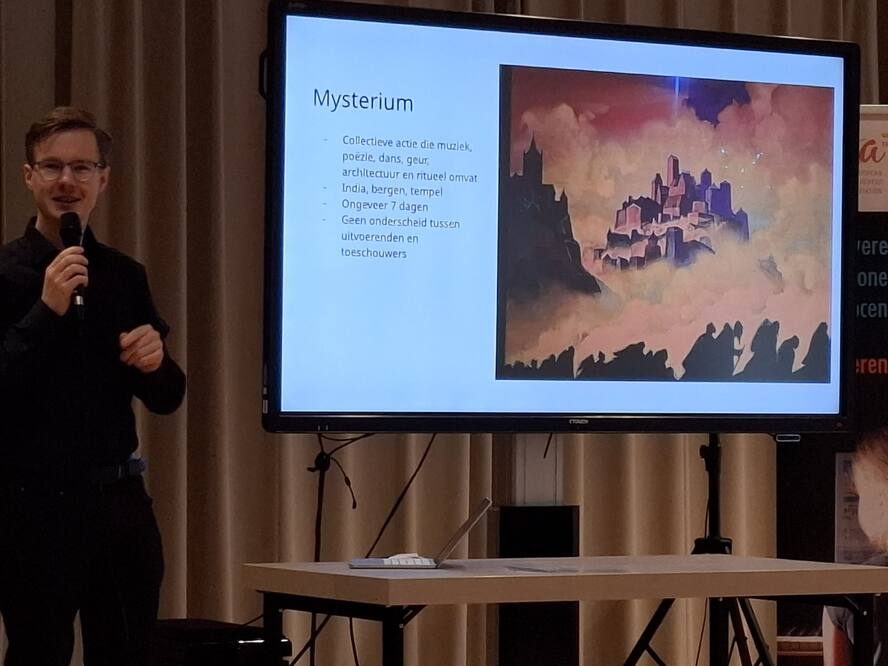
Scriabin Club founder Martin Kaptein, who was also involved in organizing the congress, presented a lecture-recital entitled Hearing Light – Scriabin’s Tenth Sonata.
The presentation explored the philosophical ideas underlying Scriabin’s final piano sonata, particularly his fascination with light, nature, and the transformation of human consciousness through art. Through musical examples and an exploration of Scriabin’s artistic worldview, Martin traced the connections between the composer’s philosophical ambitions and his musical language, culminating in a performance of the complete Tenth Sonata.
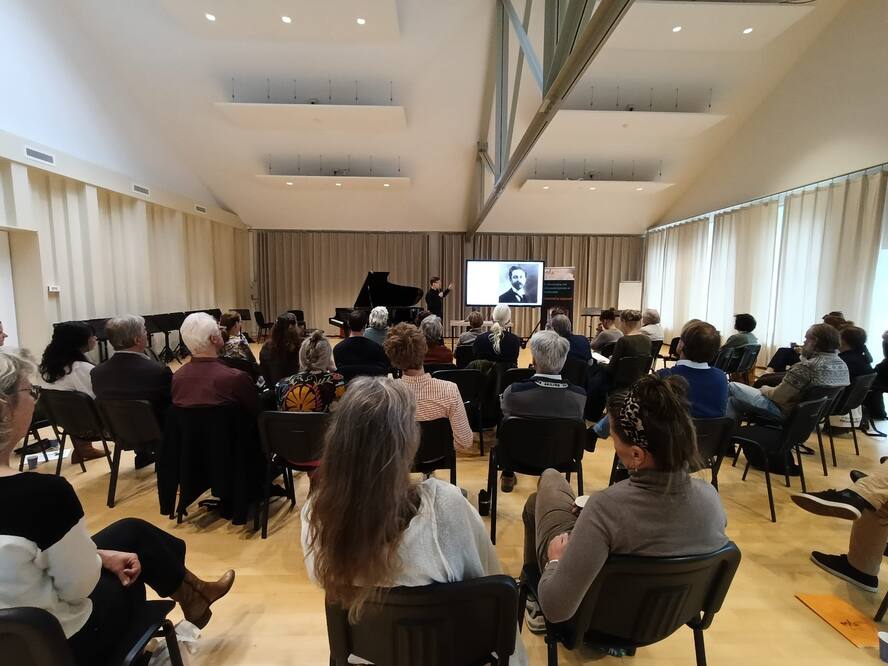
The lecture was warmly received and inspired numerous conversations afterwards. Particularly encouraging was the genuine interest in the relationship between music and ideas. There seems to be a growing appetite for exploring music not merely as a collection of sounds or technical challenges, but as an expression of deeper philosophical and artistic convictions.
For the Scriabin Club, whose mission is to explore precisely these connections, this was an especially rewarding experience.
Beyond Scriabin: New Musical Perspectives
The congress also featured many other fascinating presentations, several of which resonated with themes close to Scriabin’s artistic legacy.
Andrei Makarov presented an insightful analysis of the connections and transitions between Chopin’s 24 Preludes, Op. 28, revealing how individual pieces contribute to the larger musical architecture of the cycle. Given Chopin’s profound influence on the young Scriabin, these observations were particularly relevant.
Erney Acosta Cruz introduced his newly composed études for extended piano techniques, designed to help pianists explore the instrument’s interior and its unusual sound possibilities. These works were not only pedagogically valuable, but also musically compelling. One cannot help wondering what Scriabin might have made of such experiments! After all, in his Tenth Sonata he was already searching for new sonic possibilities, almost attempting to play between the semitones.
Isabel Gabbe, meanwhile, offered a fascinating workshop on creative, game-based approaches to piano education, demonstrating how play can encourage curiosity, musical understanding, and artistic development in young students.
These were only a few highlights of a rich programme that also explored historical instruments, improvisation, piano technique, contemporary research, and much more.
Music, Ideas, and International Connections
One of the most rewarding aspects of the weekend was its international character. Speakers and participants from different countries and musical backgrounds came together, with many presentations delivered in English. The discussions frequently extended beyond the scheduled sessions, touching on questions of artistic interpretation, philosophy, education, and the future of music.
For the Scriabin Club, the congress also provided an opportunity to introduce new audiences to Scriabin’s extraordinary artistic universe, and we were delighted to welcome several new members into our international community.
The weekend demonstrated something that lies at the very heart of the Scriabin Club: music does not exist in isolation. It is connected to philosophy, education, history, human experience, and the broader world of ideas. Even at a congress encompassing far more than Scriabin alone, his vision offered a meaningful point of connection between seemingly different subjects.
We are grateful to EPTA Nederland, all the speakers, and everyone who contributed to this inspiring weekend. We look forward to further collaborations with EPTA and other musical organizations, continuing to bring people together through music and ideas.
The complete programme and further information can be found on the EPTA Nederland website.