There is also a video version of this publication on YouTube.
Understanding Scriabin’s Actual Philosophy
Martin Kaptein
Most people - those who have even heard of Alexander Scriabin - agree that he was a great musical innovator. Some may also know that he held philosophical views. And it is precisely here that opinions begin to diverge sharply.
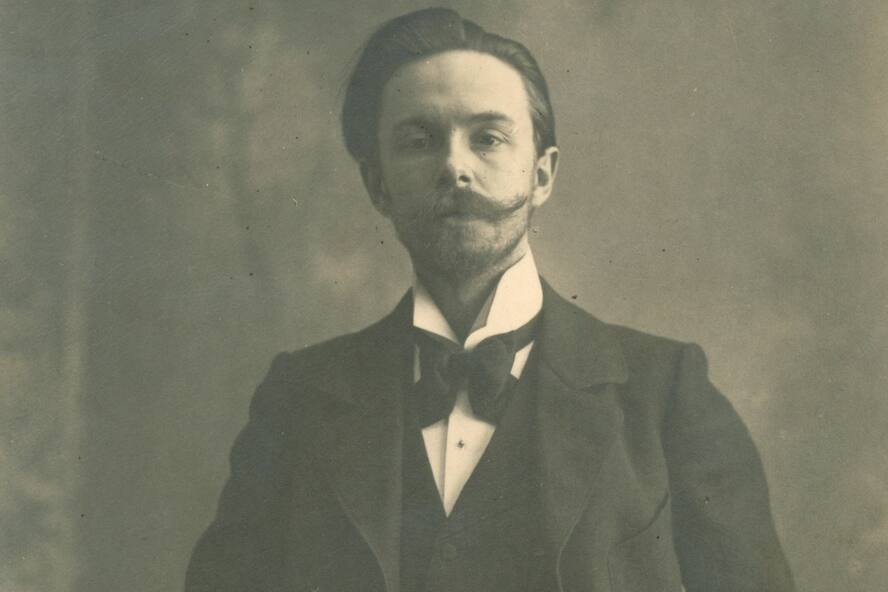
A.N. Scriabin
Scriabin is sometimes dismissed as eccentric, obscure, or even “crazy,” often by those who have not looked closely at his thought. Yet what if Scriabin’s philosophy is not only coherent, but genuinely worth engaging with? What if it holds real value for the modern world - and offers practical insight into how we understand creativity, struggle, and transformation?
This essay takes Scriabin’s philosophy seriously. Its aim is to debunk common misunderstandings and approach his ideas from a practical angle: not as abstract speculation, but as something that can illuminate life, art, and human development.
Along the way, we will see that Scriabin’s worldview closely mirrors - or in some cases predates - ideas later articulated by figures such as Schiller, Vernadsky, and Schelling. We will also encounter resonances with Christianity, Theosophy, ancient Greek thought, Taoism, and Russian Symbolism. At the same time, we will uncover fundamental differences between Scriabin and thinkers he is often superficially compared to, such as Nietzsche or Wagner. One particularly persistent misunderstanding - Scriabin’s concept of ecstasy - will require careful clarification.
What emerges is not a fragmentary or esoteric system, but a serious attempt at a global philosophy: one that envisions the transformation of humanity through creativity, and that holds a decisively positive view of the human spirit and its future. Unlike many philosophers, Scriabin did not leave his ideas on the page alone - he embodied them in music of extraordinary power. Precisely because true philosopher-composers are rare, Scriabin offers an exceptional point of departure.
On a personal note, this unique combination of philosophical depth and artistic realization is one of the reasons the Scriabin Club was founded. Scriabin possesses a quality that would be difficult - perhaps impossible - to find in any other composer.
Before proceeding, a brief disclaimer is necessary. It is impossible to paint a complete picture of Scriabin’s philosophy within a short format; the subject would easily warrant a doctoral dissertation. While this essay relies on primary and secondary sources, it inevitably also reflects my own interpretation.
A Core Statement of Scriabin’s Philosophy
A remarkably concise summary of Scriabin’s worldview appears in Leonid Sabaneev’s 1916 book on the composer - a work that remains a treasure trove of insight and, as far as I know, is still untranslated1.
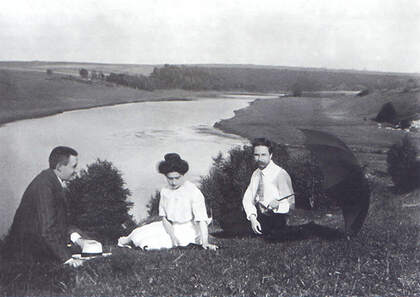
Sabaneev with Scriabin and Tatyana Schloezer
Here is my translation of the passage:
The element of creativity is a purposeless, endless becoming:
a forging of obstacles so that they may be overcome,
an eternal attaining without ever arriving.
It is the birthing of suffering and of delight,
the savoring of suffering itself and of the self-created tragedies and shadows -
and the triumphant scattering of these phantoms.Such creativity is a priceless, divine play.
And so too is the universe:
the fruit of a divine play of the World Spirit,
whose reflection within the microcosm of human nature
is the creative spirit of the artist.
At first glance, this may seem dense. In plain terms, it expresses several key ideas:
- Creativity - and by extension life itself - has no fixed final goal; it is an open-ended process.
- Obstacles are created only to be overcome; struggle is intrinsic to creation.
- There is eternal striving without definitive arrival - progress rather than completion.
- Both suffering and joy arise from this process, and even suffering can be transformed.
- Darkness and tragedy are created only to be dissolved again, revealing their illusory nature.
- Creation is a form of divine play: sacred, spontaneous, and free.
- The universe itself is the result of such divine play by the World Spirit.
- In the human being - especially the artist - this cosmic creativity is reflected in miniature.
One could say that Scriabin’s philosophy is fundamentally about the path rather than the goal. Recognizing this, paradoxically, leads to true freedom.
This brief summary only hints at the depth of the idea. To understand it more fully, we must turn to music.
Music as Philosophical Process
The passage from Sabaneev functions almost as a philosophical program for Scriabin’s Third Symphony, aptly titled The Divine Poem. Sabaneev himself describes this work as autobiographical.
The three movements can be understood as:
- Struggle
- Delight
- Divine play
There warns, however, a central paradox in Scriabin’s thought. When the spirit fully achieves a goal, something dark and sinister appears - not because victory is evil, but because finality itself is death. The spirit requires new challenges; it must continually create obstacles in order to overcome them.
This idea is reflected musically in the transition from the Fourth Piano Sonata (Op.30), which moves toward a clear culmination, to the Fifth Sonata (Op.53), which ends in an unsettling, almost circular manner - so much so that audiences were left unsure when to applaud2. Far from being a compositional quirk, this aligns precisely with Scriabin’s philosophy.
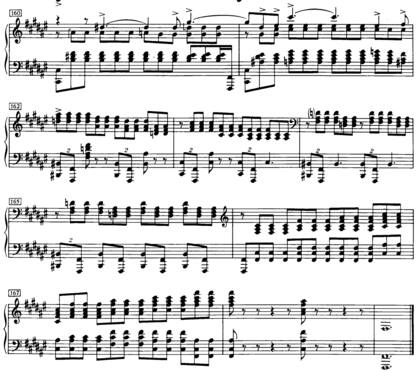
Ending of Scriabin’s 4th sonata Op.30
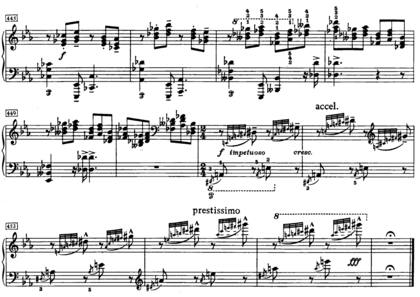
Ending of Scriabin’s 5th sonata Op.53
The Fifth Sonata captures an ecstatic flight toward an undefined destination. Where does it lead? Ultimately, that question is secondary. What matters is the spirit in motion - the creative process itself.
Rethinking Ecstasy
Ecstasy occupies a central place in Scriabin’s thought. His Fourth Symphony even bears the title Poem of Ecstasy. Yet this concept is among the most misunderstood aspects of his philosophy.
Many listeners focus on the erotic imagery associated with Scriabin and reduce ecstasy to bodily or sexual experience. This interpretation misses the point. While Scriabin acknowledged that human sexual ecstasy mirrors divine ecstasy, he regarded it as a limited reflection of a far higher state.
Bodily eroticism serves a clear biological end - reproduction. Divine ecstasy, by contrast, is purposeless in that sense. It is the ecstasy of the spirit: something that seeks continual development, higher understanding, and deeper unity.
Across cultures and religions, this idea recurs. Monastic traditions in Christianity, Buddhism, and Taoism all point toward a form of ecstasy that arises through transcendence of base desire rather than indulgence in it. Scriabin’s frequent use of suggestive imagery has undoubtedly contributed to misunderstanding, but on closer inspection his vision is far more elevated.
Moreover, surrendering entirely to bodily desire can be seen as a rejection of higher energies - a form of enslavement rather than liberation. True ecstasy, for Scriabin, emerges precisely through self-transcendence.
This interpretation is not merely personal. The researcher Andrej Bandura reaches a similar conclusion in his study of Scriabin’s Poem of Ecstasy3.
Most of Scriabin’s definitions of ecstasy transcend the boundaries of physiology and acquire a cosmic significance.
In the sphere of thought, for example, ecstasy is described as a “supreme synthesis,” expressed as “absolute differentiation and absolute unity”; it is also characterized as both a “loss of consciousness” and the “culmination of all-encompassing consciousness.”
With regard to being, ecstasy is conceived as “absolute being,” the “realization of the idea of God,” and the “harmonic flowering of the universe,” which is, however, inseparably linked to its “destruction” and “return to repose.”The feeling of “supreme bliss” that accompanies ecstasy is, according to Scriabin, connected with the “completion of the creative process,” the “limit of creative ascent,” its “final moment,” which becomes a “moment radiating eternity.”
Ecstasy, then, names something for which no better word exists - yet it is far removed from a merely sensual experience.
Prometheus and the Birth of Creativity
If The Poem of Ecstasy describes the creative process, Scriabin’s Fifth Symphony, Prometheus, goes even deeper. Here, the focus is not on the journey but on the birth of creativity itself - the primordial breath of the cosmos.
In a very literal sense, Prometheus is more sacred than the Poem of Ecstasy4.
This distinction also clarifies Scriabin’s difference from Richard Wagner. Although both envisioned a synthesis of the arts, Scriabin rejected opera precisely because it represents life rather than being life. Music, for Scriabin, was capable of real transformation.
Prometheus exemplifies this conviction. It is conceived as a symphony of light - a “psychological resonator,” as Sabaneev famously described it - intended to act directly upon consciousness.
Orphic Principles and Beyond
Scriabin’s connection to Theosophy and Blavatsky is well known, yet the extent of his engagement is often overstated. Sabaneev repeatedly notes that Scriabin read surprisingly little for a philosopher and relied primarily on his own interpretations. Sabaneev also rejects the notion that Scriabin was a conventional Theosophist, pointing to significant divergences - most notably the central role of the Mysterium in Scriabin’s thinking5.
Instead, Sabaneev identifies what he calls the Orphic principle as the guiding force behind Scriabin’s philosophy.
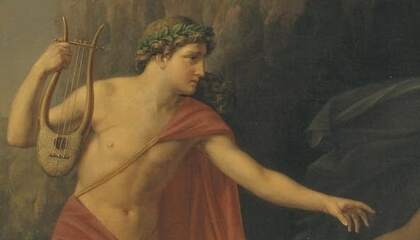
Orphism was an ancient Greek mystical tradition associated with Orpheus, uniting myth, ritual, music, and cosmology into a doctrine of spiritual transformation. It viewed the universe as harmonic, the soul as divine, and music as a ritual force capable of purifying consciousness and restoring unity.
In this light:
- Music is not entertainment but a cosmic force.
- Harmony structures the universe and affects both nature and soul.
- The human soul is divine, trapped in material existence.
- Purification occurs through ritual, music, and ethical life.
- Multiplicity represents a fall from unity.
- Ritual is performative rather than symbolic.
- Sacred acts change reality itself.
- The artist mediates between worlds, functioning as priest-musician.
In short: the universe is harmonic, the soul is divine, and music–ritual leads the soul back to unity through ecstatic knowledge.
Scriabin did not study Orphism directly, yet the parallels are striking enough to justify Sabaneev’s terminology.
Philosophical Parallels
These ideas did not exist in isolation. German Idealism, for example, developed related concepts:
- Schelling’s view of nature as visible spirit and spirit as invisible nature closely parallels Orphic thought, with art as the highest revelation of truth.
- Schiller translated metaphysics into anthropology, proposing aesthetic experience as a reconciliation of sense and reason - liberation through play.
Within Russian intellectual history, later figures such as Vernadsky articulated a living cosmos - the noosphere - from a scientific perspective, echoing intuitions Scriabin had already expressed musically.
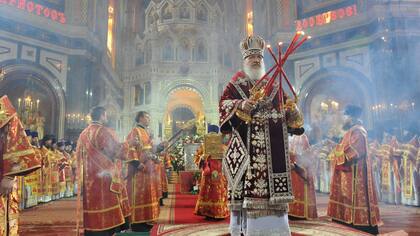
Orthodox mystical liturgy
Christianity, particularly Eastern Orthodoxy, also left its mark. Although Scriabin should not be considered religious in a conventional sense, his frequent references to musical liturgy are telling. Orthodox worship, with its emphasis on mystical participation, offers a compelling parallel:
- Theosis mirrors the Orphic liberation of the soul.
- Transformation is participatory rather than merely moral.
Bandura aptly notes that Scriabin’s philosophy “strangely combines a daring challenge to the world with Orthodox forgiveness”6.
Scriabin himself wrote:
“The world is born of resistance that I myself desired.
Life is the overcoming of resistance.Your greatest friends are your enemies,
for they awaken within you the longings you cherish most.Love your enemies,
for they have created your most beautiful feelings.”
Here, struggle is not something to be eliminated but embraced as a sacred force of development.
Nietzsche, Taoism, and the Mysterium
Is this Scriabin’s version of Nietzsche’s Übermensch? Perhaps superficially. Yet Scriabin’s biographer Schloezer doubts a deep connection, noting Nietzsche’s far more materialistic orientation7.
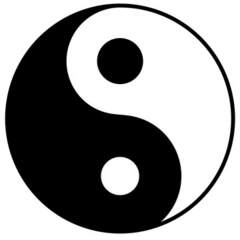
A more harmonious parallel appears in Taoism, with its emphasis on intuition, inward vision, and the union of opposites. Sabaneev himself alludes to this when he describes male and female principles as equally necessary for cosmic balance - an idea vividly embodied in the Promethean energy of Scriabin’s Fifth Symphony8.
Finally, there is the Mysterium - Scriabin’s unfinished culmination. Its concrete form remains elusive, but its intention is clear: the transformation of humanity through a synthesis of all arts9.
Sabaneev offers perhaps the most succinct insight:
Every pain must be transformed into pleasure.
After all, that’s the whole Mystery!10
Conclusion
Everything returns to the opening idea: struggle, transformation, and divine play. Scriabin’s philosophy is not fragmentary or naïve - it is coherent, radical, and deeply thought through.
While this essay can only sketch its contours, Scriabin’s worldview remains profoundly relevant. It invites us to rethink creativity, suffering, and the future of humanity - particularly in turbulent times.
I would like to conclude with a line by Lunacharsky, which captures the spirit of Scriabin’s vision:
“He teaches us not to fear suffering,
not to fear death,
but to believe in the triumphant life of the spirit.”11
-
Sabaneev. Scriabin. 1916. Page 19. [Russian]. ↩︎
-
Sabaneev. Reminiscences of Scriabin. 2000. Page 37. [Russian]. ↩︎
-
Bandura. Scriabin - Poem of ecstasy. 2009. Chapter 3. [Russian]. ↩︎
-
Sabaneev. Scriabin. 1916. Page 28. [Russian]. ↩︎
-
Sabaneev. Scriabin. 1916. Page 38. [Russian]. ↩︎
-
Bandura. Scriabin - Poem of ecstasy. 2009. Chapter 2. [Russian]. ↩︎
-
Schloezer. Scriabin - Artist and Mystic. 1987. Page 119. [English]. ↩︎
-
Sabaneev. Scriabin. 1916. Page 45. [Russian]. ↩︎
-
Schloezer. Scriabin - Artist and Mystic. 1987. Page 8. [English]. ↩︎
-
Sabaneev. Reminiscences of Scriabin. 2000. Page 203. [Russian]. ↩︎
-
Bandura. Scriabin - Poem of ecstasy. 2009. Chapter 7. [Russian]. ↩︎